

Have you ever felt like..
- You have a lot of customers but don’t know where to start?
- Who deserves a special promotion?
- Who’s about to disappear from your radar?
If so… we recommend the RFM Model — a classic tool that still works wonders.
What is RFM?
RFM stands for:
- Recency (R): How recently a customer made a purchase
- Frequency (F): How often they make purchases
- Monetary (M): How much they have spent in total
These three variables are enough to understand customer behavior.
How to Do Simple RFM Segmentation (No Complex Formulas Needed)
1. Prepare Your Data
- Export your customer list
- Include: last purchase date, number of purchases, total spending
Customer Segmentation and Membership Tiering Learn More

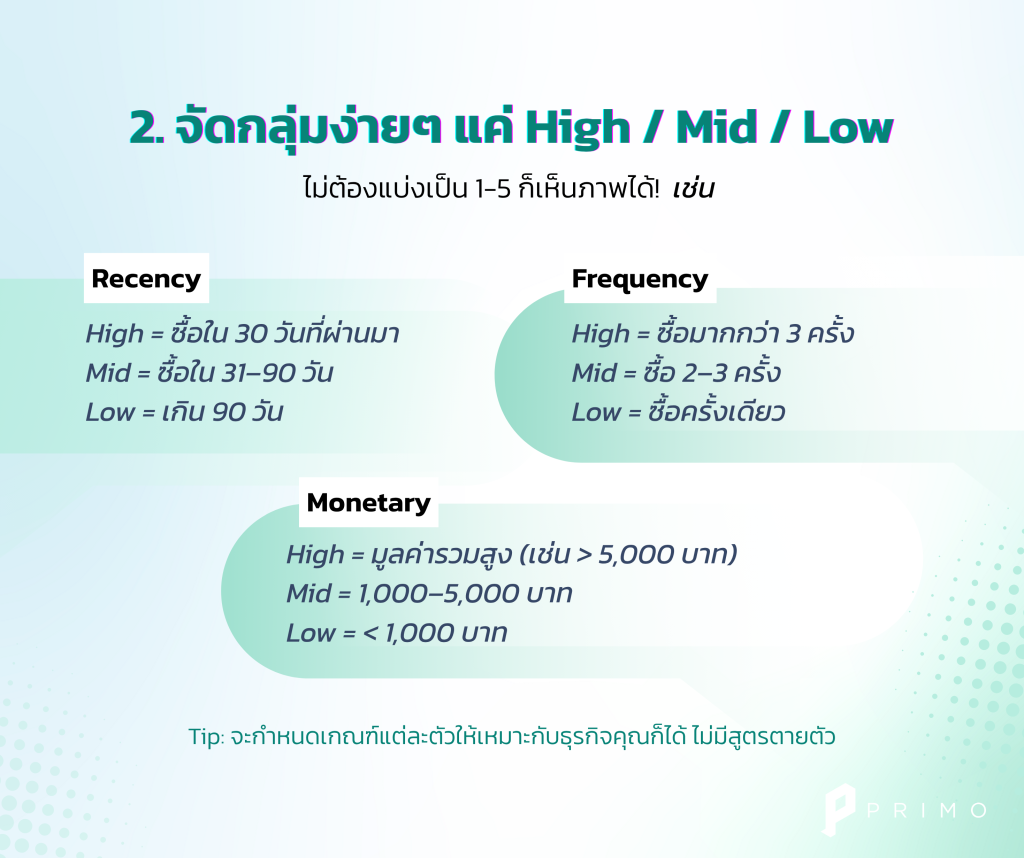
2. Categorize into High / Mid / Low
Example of simple criteria:
Recency (R):
- High = Purchased within the last 30 days
- Mid = 31–90 days
- Low = More than 90 days
Frequency (F):
- High = More than 3 purchases
- Mid = 2–3 purchases
- Low = 1 purchase
Monetary (M):
- High = More than 5,000 THB
- Mid = 1,000–5,000 THB
- Low = Less than 1,000 THB
 Tip: Adjust the criteria to fit your own business. Tip: Adjust the criteria to fit your own business. |
Example Segments Based on RFM
| Segment | Description | Recommended Strategy |
|---|---|---|
| R-High / F-High / M-High | VIP Customers | Send exclusive offers, invite to clubs |
| R-Low / F-High | At Risk | Launch a Win-back campaign |
| R-High / F-Low | New Customers | Send onboarding and welcome gifts |
| F-Low / M-Low | Low ROI | Reduce focus or pause campaigns |
SummaryRFM segmentation doesn’t require complicated formulas or scoring systems. Just segment simply and communicate to the right group — that alone can drive results. |